
Structure Creates Stronger Focal Points
from Colley Whisson
When you're faced with a blank canvas, it can be tempting to dive into the details—the sparkle of the water, the branches on the trees, the texture of a roofline. But if you haven’t built a strong structure underneath it all, even the most beautiful details won’t hold the viewer’s attention.
Structure is what gives your painting clarity, direction, and focus. Whether you're working in watercolor, oil, or acrylic, structure helps you guide the viewer’s eye, create balance, and simplify complex scenes.
Here are some core principles and techniques for using structure to support your focal point and strengthen your overall composition.
Start with Big Shapes
One of the most important steps in composing a scene is to look past the details and identify the large, foundational shapes.
Take a coastal scene by Herbert as an example. At first glance, it may seem full of intricate details, but when you break it down, you’ll notice it’s built on just a few dominant shapes: a headland here, a mass of water there. These large shapes form the “skeleton” of the painting—its underlying structure.
Tip: Don’t worry about having a delicate hand at this stage. What matters most is measuring where shapes begin and end, and placing them accurately on your canvas.
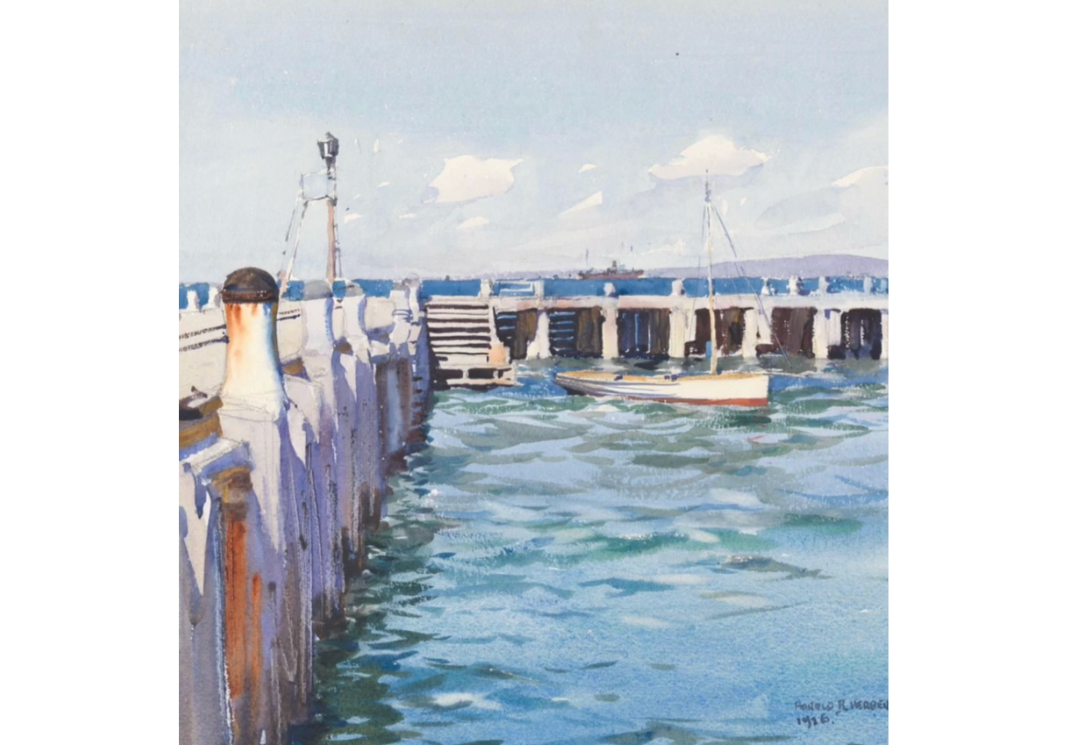
“The Pier at St Leonard's”, 1926, Harold B. HERBERT
Use Lines to Lead the Eye
Lines—both obvious and subtle—can be powerful compositional tools. Look for ways to use elements like roads, fences, shadows, or architectural edges to guide the viewer toward your focal point.
Some lines may be literal (a pier leading into the distance), while others are implied (the angle of a hillside or the curve of a tree). The key is to have intentional directionality that supports your point of interest.
Try this: After sketching your scene, ask yourself: “Where does the viewer’s eye go first? And then where?”
Anchor the Scene with Value Contrast
Contrast is a natural magnet for the eye. If you place your strongest darks near your focal point, you’ll give it more weight and importance. This doesn’t mean your darkest dark has to be black—it just needs to stand out in comparison to its surroundings.
In a well-structured painting, a few carefully placed darks or accents can do more than an entire area filled with detail.
Practice: Squint at your painting. Can you clearly identify where the visual “anchor” is? If not, refine your value structure.
Simplify, Don’t Overwork
It’s easy to over-engineer a scene, especially in the studio where there’s time to keep adding. But too much detail can flatten your focal point and overwhelm the viewer.
Some of the most effective paintings are ones that leave certain areas understated, allowing the eye to rest and focus where it matters most. Simplicity builds clarity, and clarity creates impact.
Reminder: Not every surface needs texture. Not every shadow needs variation. Let the eye travel easily and intentionally.
Use Composition to Create Flow
Strong compositions often have a natural rhythm or flow—usually formed by a triangle of interest or an interplay of odd-numbered shapes and repeating patterns.
Whether it’s figures, trees, boats, or rooftops, try arranging your elements in a way that helps the viewer move through the painting comfortably. Avoid dead zones or isolated objects that interrupt the eye’s journey.
Guideline: A viewer should be able to move from top to bottom, left to right, and diagonally across your piece without getting “stuck.”
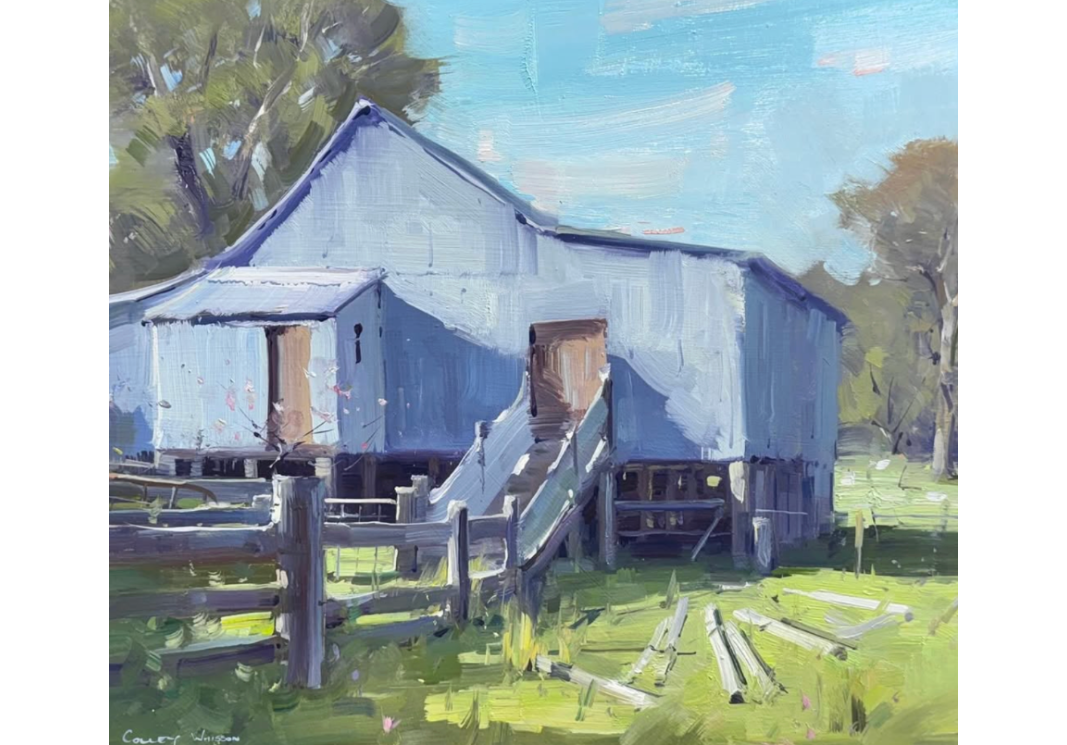
By Colley Whisson
Balance Spontaneity and Planning
Painting on location (plein air) can teach you to work quickly and focus on structure. With limited time, you’re forced to prioritize the essentials—shapes, light, composition—before detail.
In contrast, studio work can lead to overthinking. While the studio offers control, it also makes it easier to lose the freshness that comes from working directly and with purpose.
Balance tip: Use your studio time to refine ideas, but keep the energy and clarity of your on-location sketches.
Let Structure Be Your Guide
Structure isn’t about making a rigid blueprint—it’s about giving your painting a foundation. When your big shapes are solid and your lines lead with intention, everything else—color, texture, detail—has a place to belong.
Before you add in the detail, ask:
Are my shapes balanced?
Is the focal point clear?
Does the eye move naturally?
If the answer is yes, then you’ve set yourself up for a strong, compelling painting.
Want to build stronger compositions? Start with structure. It’s the quiet backbone of every great painting—and the key to capturing and holding your viewer’s attention.
Want more from Colley? Join him below: