
Why Perspective Is the Foundation of Painting Water
Skip's central teaching is that perspective governs everything about how water should be painted — not only along the shoreline, but within the reflections themselves. The same body of water reads completely differently depending on the viewer's vantage point, and the painter's job is to translate that vantage point honestly onto the canvas.
He breaks the subject into two broad situations:
The standard view — water seen at or near eye level, where level lines dominate.
The high vantage point — water seen from above, where diagonals, curves, and dark reflections take over.
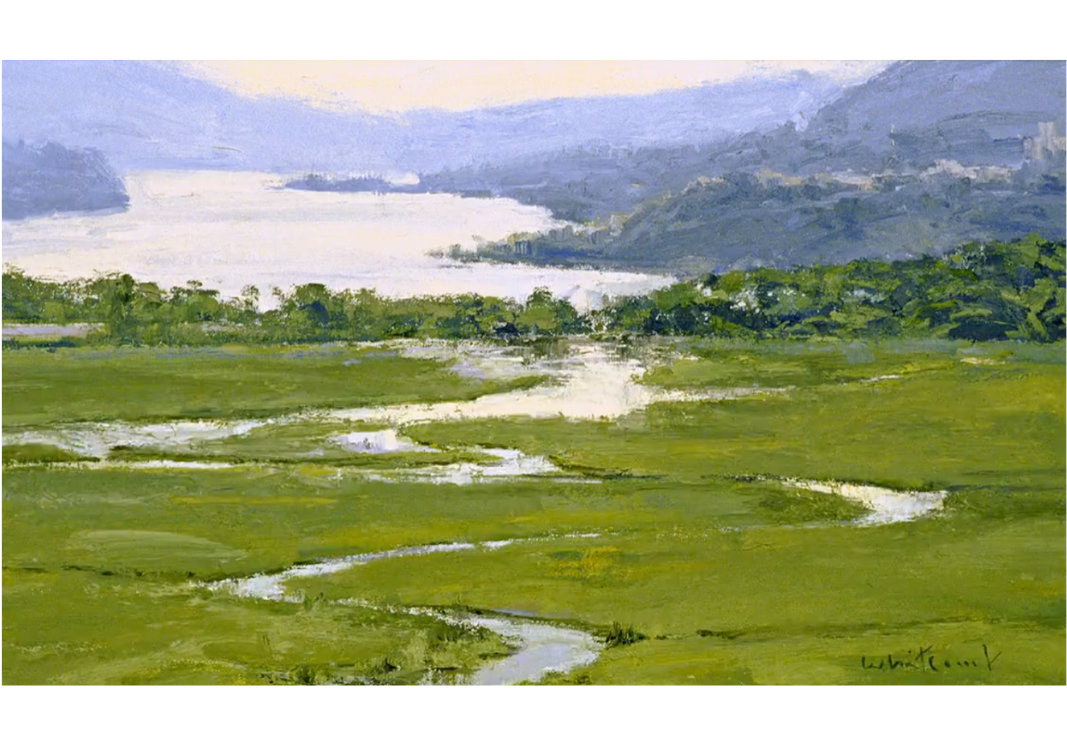
Painting Water at Eye Level: The Power of Level Lines
At eye level — what Skip calls the "normal" perspective on water — the painter's first responsibility is to emphasize level lines: horizontals that run parallel to the top edge of the canvas. Strong horizontals in the reflections are what tell the viewer, unmistakably, this is water, and this is the level of the water.
But unrelieved horizontals become monotonous, so Skip deliberately breaks them up using a few reliable devices:
Interruptions in the reflection. Anything sitting on the water — a duck, a rock, a piece of debris — causes the reflection to "take a jump," breaking the strong horizontal.
Verticals in the landscape contrast against the level water lines and add variety.
Ripples create motion. Subtle, slightly circular ripple movement can carry the eye through a reflection rather than letting it sit static.
Diagonals in the water add energy, even if they have to be exaggerated slightly beyond what was strictly there in nature to serve the composition.
Subtle Diagonals Explain the Water's Behavior
Even at eye level, water is rarely perfectly still. Skip uses very subtle diagonals to begin explaining what the water is doing, while the dominant levels in the surrounding landscape keep the viewer anchored to the water's true plane.
Reflections: The Rules That Tell the Viewer "This Is Wet"
Reflections are Skip's primary device for explaining wetness, and he returns often to one core principle:
A light object reflects darker in the water, and a dark object reflects lighter in the water.
Applied in practice:
The sky's reflection is darker than the sky itself — noticeably darker in value. Getting this relationship right is what convinces the viewer that the surface is wet.
Reflections of rocks along a shoreline are essential to explaining wetness. Picking them up in the water surface sells the whole illusion.
Wet sand is darker than dry sand, often considerably so.
Wet rocks are darker than dry rocks. Rocks being washed by waves darken dramatically, and painters routinely underestimate how much.
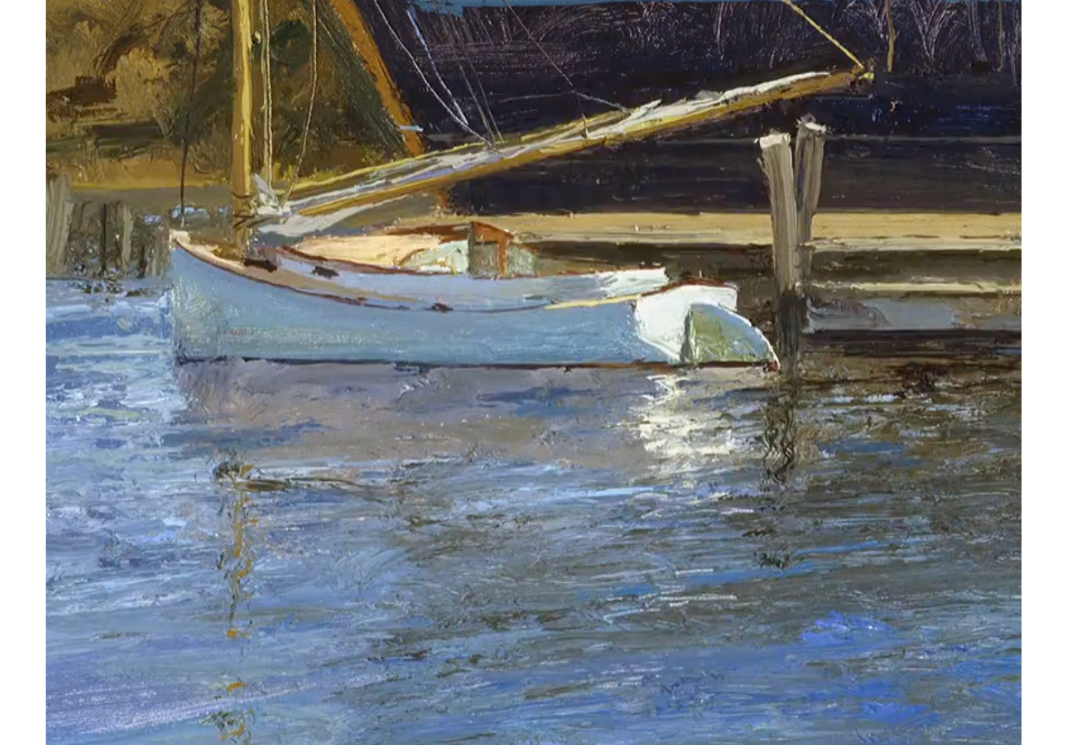
Don't Paint Water Too Light
Skip warns of a common inclination: painting water — especially ocean water — too light. While it's certainly possible to go too dark, the ocean contains very dark passages that sit against lighter halftones where the surface catches sky reflection. Respecting those deep values is part of what makes marine painting convincing.
The Subtle Swell: An Alternative to Crashing Waves
Skip is often more drawn to the quiet moment before a wave breaks than to the drama of the crash itself — the long sweeping lines drawing up the face of a swell, the slide of a large mass of moving water, the first hint of white water just beginning to climb a rock. Level lines still matter in these quieter passages: they contrast with the curve of the swelling water and keep the scene readable.
Looking Down on Water: When Levels Become Diagonals and Curves
The heart of this lesson is the high vantage point — the perspective of looking down on water, rather than viewing it at eye level.
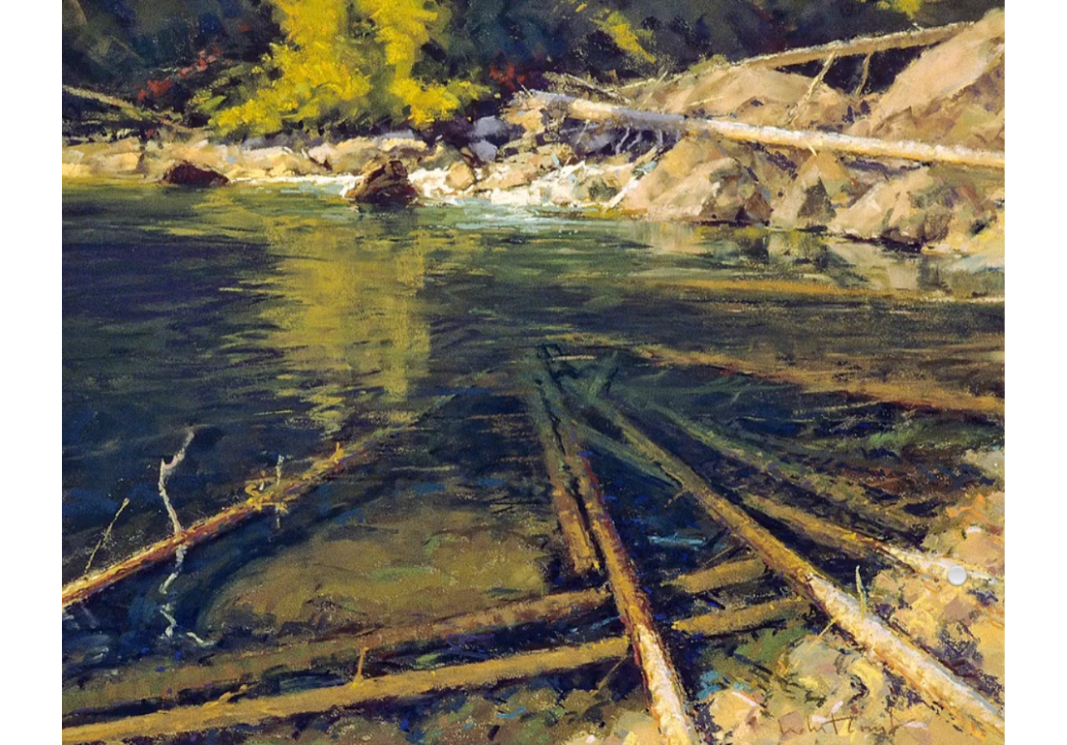
What Changes When You Look Down
Reflections take on curved motion. As water flows into a cove or against rocks, it's pushed back outward in what Skip calls a "mass reflection" — a bounce-back of the whole volume of water. Those curves become critically important, because they explain what the water is actually doing.
The water becomes much darker. Looking nearly straight down into water, the surface reflects the sky directly overhead — the zenith, the darkest point of a blue sky. So the sky reflection reads naturally darker than it would at eye level.
Dark reflected notes carry the story. Small dark notes in the water — reflections of sunlit rocks, typically a couple of values darker than the rocks themselves — follow the light-reflects-darker principle and add character.
Levels become diagonals. Because the horizon and vanishing points sit far above the water when looking down, the lines that would read as levels at eye level now read as diagonals. Getting that perspective right is what makes a looking-down view convincing.
Study the Cause of the Ripples
Skip urges painters to pay close attention to the patterns of ripples and to understand their cause — most often the bounce-back of water rebounding off rock formations. Ripples aren't decoration; they're evidence of physics, and the viewer senses when they're right.
How to Study Moving Water: Three Field Methods
Beyond painting itself, Skip teaches a practical progression for studying water as a subject.
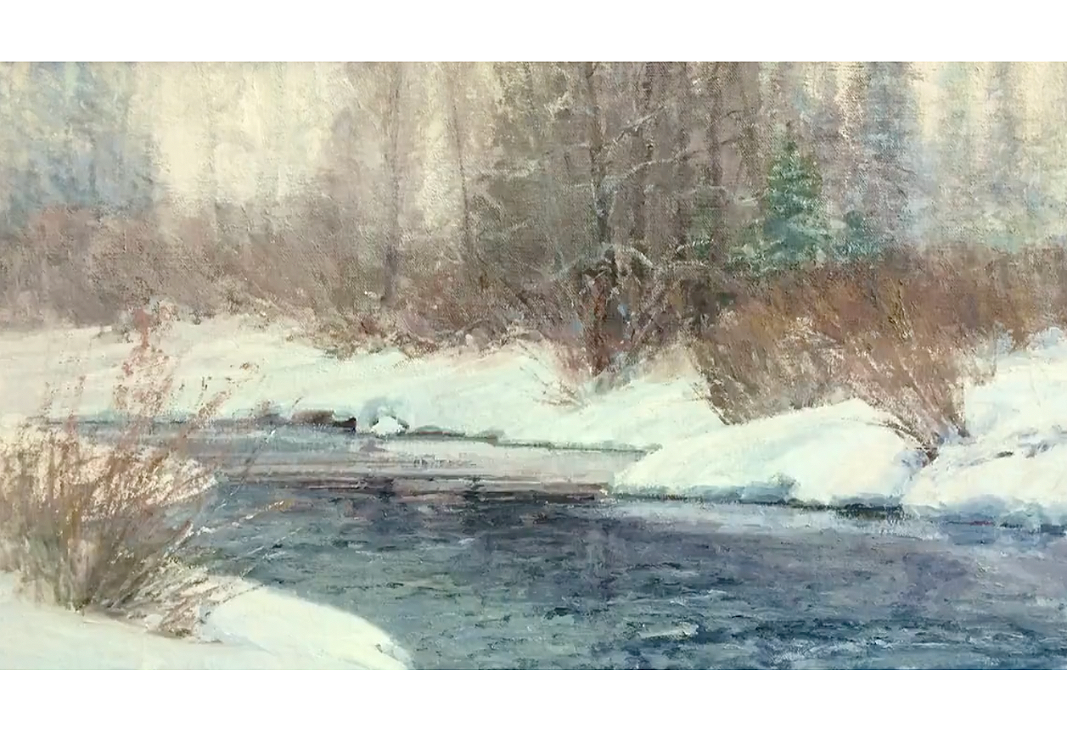
1. Reference Photographs — Bracket Your Exposures
Skip recommends shooting the same scene at more than one exposure: a lighter exposure to capture detail in the reflections, and a darker exposure to hold onto information that would otherwise blow out. Exposing for different things ensures good information in both the lights and the darks — something a single photograph of high-contrast water rarely provides.
Composing reference photos deliberately also helps. Placing the horizon near the top of the frame, for instance, lets distant water read in level lines while the nearer water, seen from above, shifts into steeper perspective — capturing both conditions in a single reference.
2. Sequence Shots
Shooting a rapid series of the same subject — a swell approaching, the moment it breaks, the next swell building — lets the painter study the full cycle of a wave. A sequence typically reveals:
The descriptive lines on the face of an approaching swell
Foamy areas that explain the surface
Long striations of water after the break, before the true white water
Water falling back off a rock formation after a wave has broken
How dark the wet rock and draining water actually are
"There's a logic behind water and shoreline," Skip says — and sequence shots make that logic visible.
3. Video — The Deepest Study Tool
Skip's strongest recommendation is to take videos of moving water — not only the ocean, but creeks, rivers, streams, waterfalls, and small drops where a stream falls over rocks. Video allows the painter to:
Scrub back and forth to watch how a swell approaches and breaks
Slow down or freeze the footage to find verticals and sweeping curves invisible at full speed
Advance frame by frame to truly understand the action
Capture screenshots to build an entire reference sequence from a single clip
Video teaches values, perspective, and the entire action of moving water in a way a single still never can.
Key Takeaways from Skip Whitcomb on Painting Water in Perspective
At eye level, emphasize level lines parallel to the top edge of the canvas — they tell the viewer where the water's surface is.
Break the horizontals deliberately with reflections, verticals, ripples, and diagonals to create movement and variety.
A light object reflects darker; a dark object reflects lighter. The sky's reflection is always darker than the sky.
Looking down, everything changes: levels become diagonals, ripples become curves, and the water darkens because it reflects the zenith of the sky.
Reflections of rocks, wet sand, and wet rock are all darker than beginners expect — resist the urge to paint water too light.
Use bounce-back ripple patterns compositionally to wrap and envelop your subject, as the masters have.
Study water with bracketed photos, sequence shots, and especially video, using freeze-frame to understand the logic of moving water.