
The Basic Recipe for a Strong Painting
Lessons from Eric Jacobsen’s Approach to Design, Value & Visual Harmony
A strong painting rarely happens by accident. While every artist develops a personal voice over time, there are foundational ideas that consistently appear in successful paintings. These principles help organize visual chaos into something clear, compelling, and emotionally engaging.
According to artist Eric Jacobsen, painting becomes much more manageable when artists focus on a few essential ingredients rather than trying to chase endless details. Instead of overcomplicating the process, he encourages painters to think in terms of structure, rhythm, value, color harmony, and intentional brushwork.
At the heart of his philosophy is a simple idea:
Great paintings are built, not copied.
Start With a Clear Focal Point
Every strong painting needs a center of interest. This is the place where the viewer’s eye naturally wants to rest. It becomes the “main character” of the visual story.
Eric often points out that successful painters intentionally guide the eye toward this focal area through:
Value contrast
Color contrast
Directional lines
Repetition of shapes
Edge control
Placement of warm and cool color relationships
In master paintings, the focal point is rarely random. The artist carefully designs the composition so everything subtly points toward that area.
For many painters, this is where paintings begin to improve dramatically:
not by adding more detail, but by creating clearer visual hierarchy.
Value Is the Backbone of the Painting
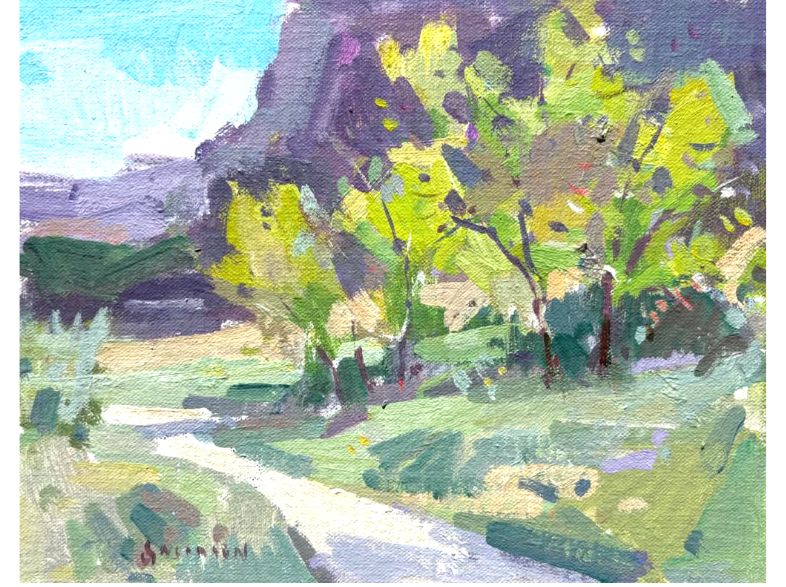
One of the most important concepts Eric emphasizes is value range. A painting with a strong range of darks and lights immediately feels more believable and more alive.
He often explains that without strong darks, light cannot appear luminous.
This relationship is critical in landscape painting:
Dark accents make sunlight feel brighter
Mid-tones create atmosphere
Reflected light gives form dimension
Close shadow values maintain harmony
Many struggling painters accidentally compress their values too closely together. The result is often a flat, muddy, or confusing image.
Eric encourages artists to simplify and organize values first before worrying about color complexity.
A successful painting usually has:
A clear separation of light and shadow
Controlled transitions
Grouped shadow masses
Intentional value contrast near the focal point
This principle alone can transform a painting.
Color Harmony Matters More Than “Pretty Color”
Many artists chase intense color without understanding harmony. Eric’s teaching consistently brings painters back to relationships rather than isolated colors.
Warm and cool relationships play a huge role in creating visual unity.
Rather than using every color available, strong painters often repeat color families throughout the painting:
Warm notes echo in multiple areas
Cool passages repeat across shadows and sky
Complementary colors are used strategically
High chroma is reserved for emphasis
One powerful observation Eric makes is how master painters use complementary colors near the focal point to create excitement without overwhelming the entire painting.
This restraint creates sophistication.
Instead of screaming color everywhere, the painting breathes.
Brushwork Creates Energy
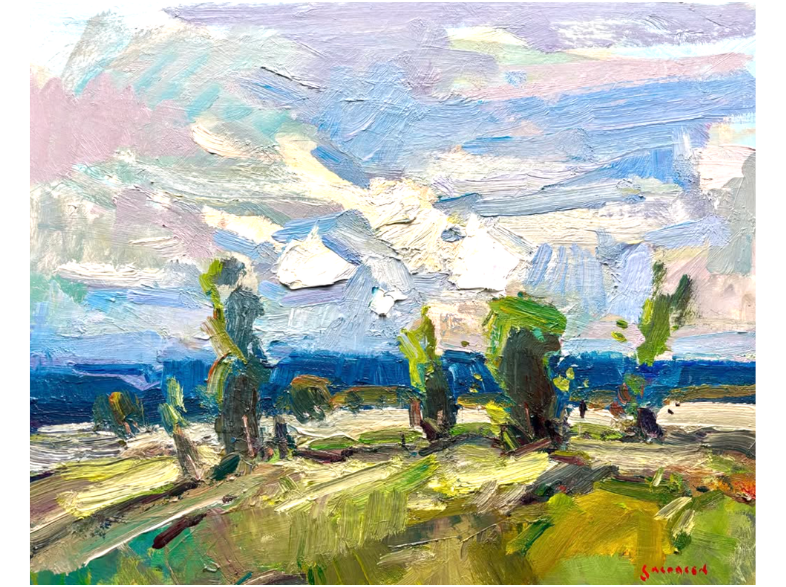
Brushwork is not decoration. It is part of the structure of the painting.
Eric frequently refers to brushwork as “mark making,” and he encourages artists to vary their marks intentionally.
Strong paintings often contain:
Quiet passages
Active passages
Thick marks
Thin marks
Soft transitions
Sharp accents
This variation creates rhythm and movement throughout the composition.
A sky, for example, may remain calm and simple, while foreground passages become more energetic and textured. This contrast keeps the viewer engaged.
One of the great mistakes many painters make is treating every inch of the canvas with equal intensity.
Master painters know where to simplify.
Shape Design Is More Important Than Detail
Eric repeatedly reminds artists to think in terms of shape, not objects.
A painter should not obsess over:
Every nail in a barn
Every leaf on a tree
Every ripple in water
Instead, they should ask:
What is the overall shape?
What is the light shape?
What is the shadow shape?
How do these shapes connect?
This approach immediately simplifies complex scenes.
Strong paintings are usually built on strong abstract shapes before any detail is added.
In many ways, painting becomes far easier once artists stop trying to copy everything literally.
Overlap Creates Depth and Interest
One of the lesser-discussed ideas Eric highlights is overlap.
Overlap is a simple but powerful design tool:
Trees crossing buildings
Foreground grasses overlapping reflections
Branches cutting through sky shapes
One object partially obscuring another
These overlaps create:
Depth
Spatial relationships
Tension
Interesting negative shapes
Many beginner paintings feel flat because objects sit beside each other rather than interacting spatially.
Overlap creates visual layering and helps the viewer move through the painting naturally.
Rhythm and Movement Keep the Eye Traveling
Great paintings rarely feel static.
Eric explains that repeating shapes, lights, darks, and marks create movement throughout the composition.
This repetition allows the eye to “skip” around the painting.
Examples include:
Repeated warm notes
Scattered cool accents
Echoed brush marks
Recurring shape patterns
Broken edges
This visual rhythm is what often separates a painting that feels alive from one that feels stiff.
The Recipe Is Simple — But Not Easy
Eric’s “basic recipe” for painting is not about formulas or rigid rules. It is about awareness.
As artists begin a painting, these ideas should stay near the front of their mind:
Focal point
Value range
Color harmony
Brushwork
Shape design
Rhythm
Overlap
Balance
Movement
The more intentionally these elements are designed, the stronger the painting becomes.
And perhaps most importantly, artists begin to realize that successful paintings are usually built from a handful of timeless principles repeated consistently and thoughtfully over time.