
How to See and Mix Sky Colors
from Mitch Baird
One of the questions Mitch Baird often gets from painters is simple on the surface but more complex in practice: How do you mix sky color?
At first, it may seem like the answer should be straightforward. Many artists assume a sky is just blue plus white. But Mitch teaches that skies are far more nuanced than that. To paint them well, an artist has to move beyond formulas and start paying close attention to value, temperature, atmosphere, and the way light affects everything in the scene.
For Mitch, the sky is never just a background. It is an active part of the painting’s structure, and it has to relate to the land, the light, and the mood of the day.
Start With Clean Color
When Mitch mixes sky color on his palette, he begins with one practical rule: keep the mixture clean.
Because sky color often needs to feel rich and luminous, muddy paint can ruin it quickly. Mitch is careful to pull fresh white and fresh pigment from uncontaminated paint piles rather than dipping into areas that have already been mixed and dirtied with a brush or knife.
That matters because the sky often depends on clarity. If the color gets dulled too soon, it loses its brilliance.
But even with that in mind, Mitch does not treat every sky as the same mixture. He does not believe there is one perfect recipe that works every time.
A Sky Is Not Always Just Blue
One of the biggest mistakes painters make is assuming the sky is always some version of blue.
Mitch teaches that every sky has its own color character. Some skies lean cooler. Some lean warmer. Some carry violet, yellow, pink, gray, or even subtle green notes depending on the light and atmosphere.
For example, in alpine settings, Mitch often sees skies that are darker in value and carry more purple. In that case, a warmer blue like ultramarine may be more useful than cobalt. On other days, when the sky feels crisp and cool, cobalt may be the better choice.
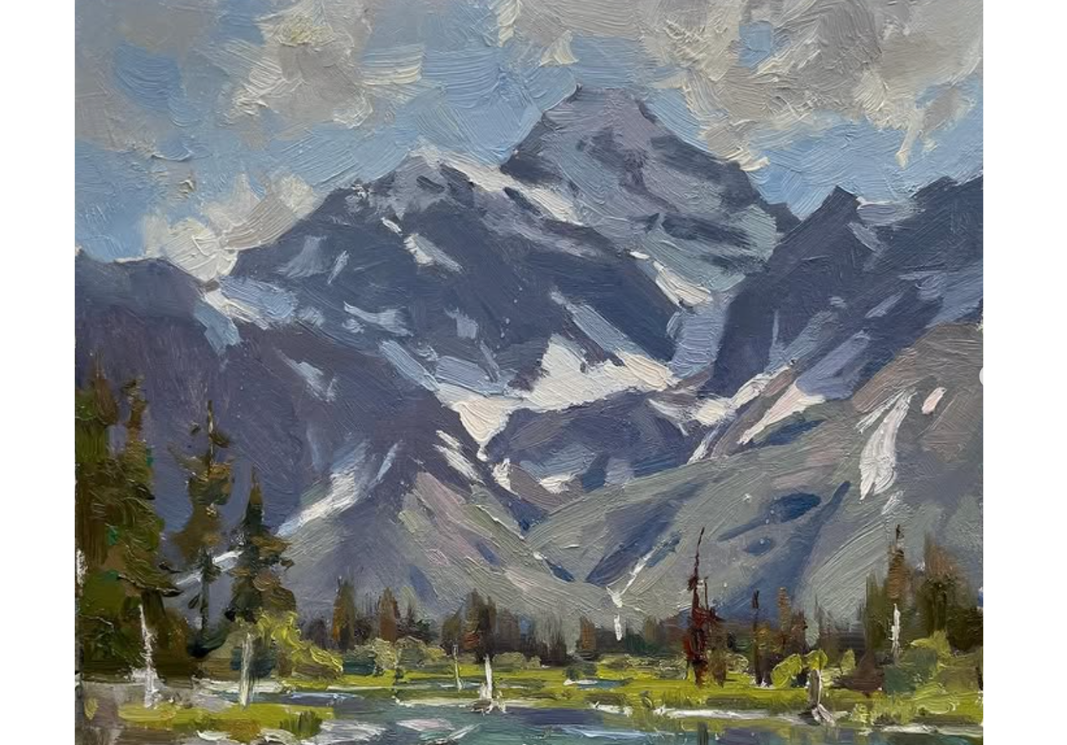
Sometimes a sky may even need a touch of cadmium lemon or viridian to suggest a warmer yellow-blue effect. The point is not to force the sky into a fixed formula. The point is to observe what is really there.
Observation Matters More Than Formula
Mitch returns again and again to the same principle: there is no one way to mix a sky.
That is because the sky changes constantly depending on conditions. The sun’s position, cloud cover, moisture in the air, fog, distance, time of day, and season all influence what the artist sees.
A clear midday sky does not behave like an evening sky. A foggy morning does not behave like a dry high-altitude afternoon. A sunset sky may appear muted and gray in some areas, allowing the land to look richer by contrast.
This is why Mitch encourages painters to think relationally. Sky color must be judged in context. It must be compared to the land, the light, the shadows, and the atmosphere around it.
Why Painting From Life Teaches More Than Photography
A major part of Mitch’s teaching is the reminder that photographs often fail to tell the full truth about color.
Cameras make decisions for the artist. They often cool off the sky, flatten subtle temperature shifts, and ignore delicate notes that were visible in real life. A painter standing outdoors may see warmth in the atmosphere, faint pinks in the sky, or a soft yellow glow near clouds that the camera simply does not record.
That is why Mitch values painting from life so highly.
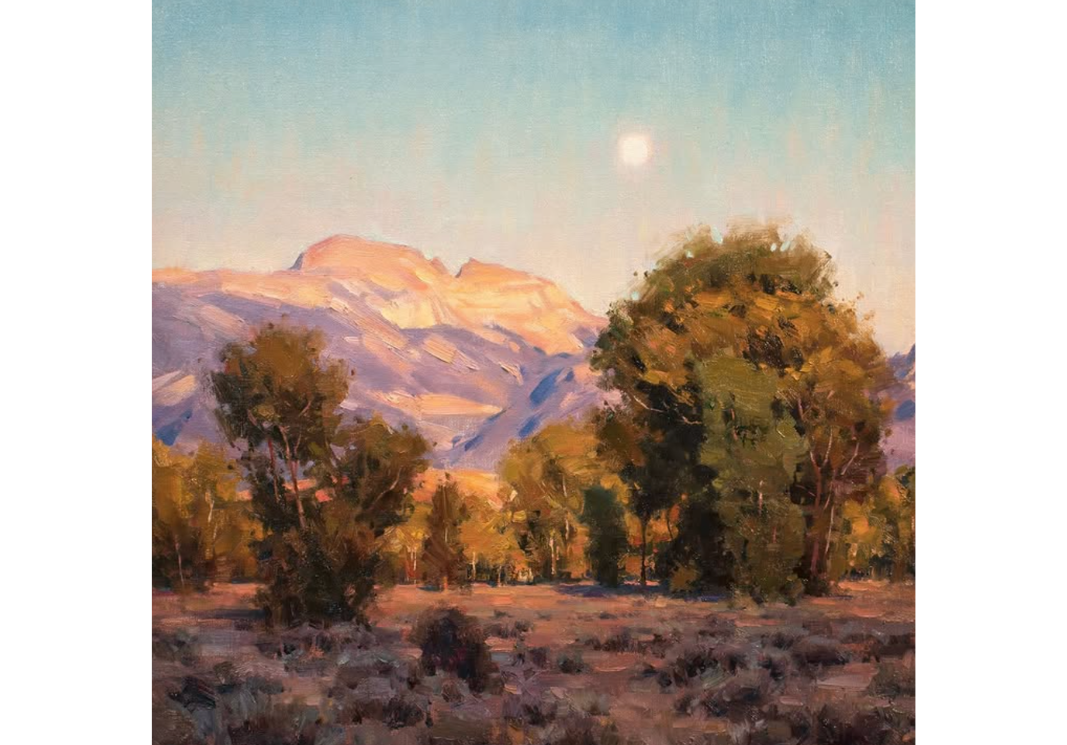
When he paints outdoors, he pays attention to the first color notes he sees and gets them down early. Those initial notes become anchors that help him understand the rest of the scene. Even a pale gray-blue or a slightly warm off-white in the sky can establish a relationship that guides the painting from beginning to end.
Later, when he returns to the studio, those direct observations matter more than the photograph.
Sky Color Often Reflects the Light in the Landscape
One of Mitch’s most useful ideas is that the sky and the landscape often share the same light story.
If warm yellow light is affecting the snow, that same warmth may also be present in the sky. If the shadows in the landscape are full of warmth bouncing around, some of that visual temperature may appear in the atmosphere as well.
This is where painters can begin to see the sky not as an isolated shape, but as part of a larger system.
Mitch looks for those connections. If he sees a rich yellow behind a cloud and that same yellow affecting the ground plane, he knows the temperature belongs to the overall lighting condition. That consistency helps unify the painting.
Warm to Cool Shifts Across the Sky
Another important lesson Mitch teaches is that skies often shift in temperature from one side to the other.
If the sun is low on one side of the composition, that area of sky may hold more warmth. As the painter moves farther away from the sun’s influence, the sky may cool gradually. Clouds may shift too. A cloud near the warm light may appear lighter and warmer, while the same cloud shape farther across the sky may feel cooler and darker against the zenith.
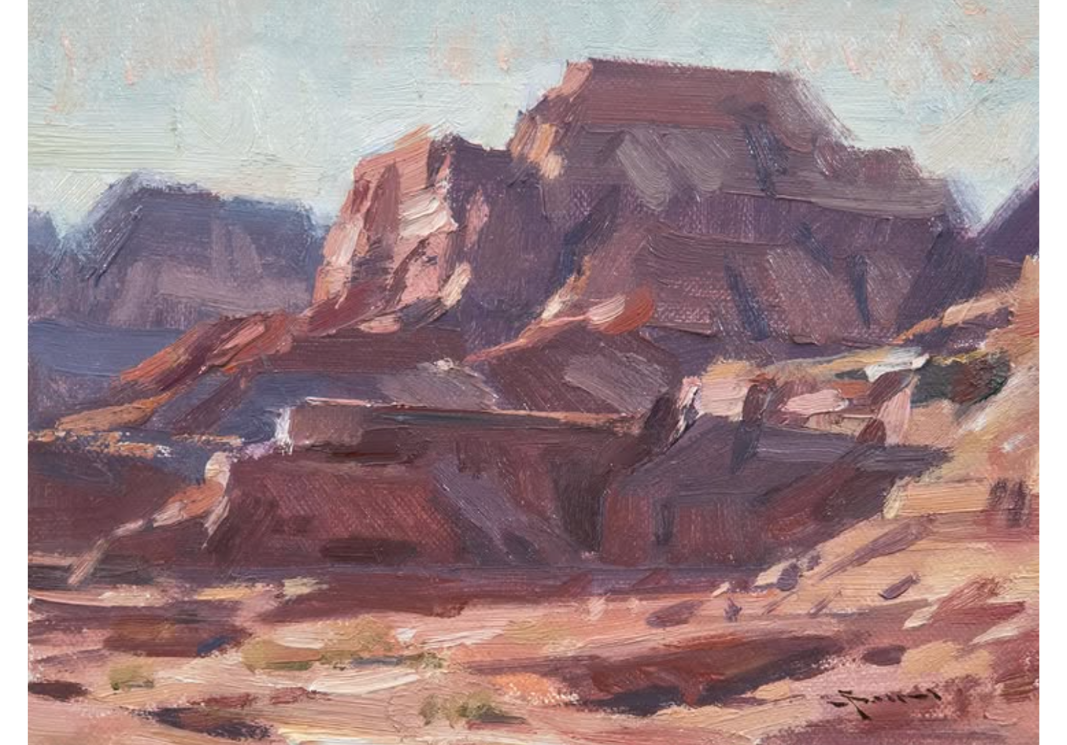
These shifts help explain the direction of light and give the painting more believability.
They also make the sky more interesting. Rather than filling the whole shape with one flat mixture, Mitch studies how temperature moves across the sky and lets that movement support the design of the painting.
Value Carries the Sky
If Mitch had to emphasize one thing above all else, it would be this: value carries the sky.
Color matters, but value is what makes the sky feel convincing.
If the sky is too dark, it can lose its sense of light. If it is too light in the wrong way, it may no longer relate correctly to the landscape. The artist has to judge how light or dark the sky is compared to everything beneath it.
This is especially important because photographs often distort value relationships just as much as they distort temperature. Mitch watches for this carefully. He adjusts what he sees in order to hold onto the actual feeling of light rather than blindly copying what the photo gives him.
For him, value is the structure that supports everything else.
Helpful Color Tendencies Mitch Watches For
Although Mitch does not teach sky mixing as a formula, he does share some useful tendencies that painters can keep in mind:
If the sky leans violet, ultramarine may be the better blue.
If the sky feels crisp and cool, cobalt may be the better choice.
If the sky has a yellow cast, a touch of lemon yellow can warm the mixture.
Viridian can also help create a warmer yellow-blue effect.
Clean mixtures are essential if the sky needs to stay luminous.
Warm, cool, muted, or gray skies all depend on the condition of the light.
These are not rules. They are tools.
Take Notes When the Camera Fails
Because photographs often miss subtle sky effects, Mitch recommends making notes in the field.
That could mean a quick written observation in a notebook, a note in a phone, or simply training the eye to remember what the camera left out. If the photograph cools everything down or loses the warmth in the clouds, those notes can be incredibly valuable later in the studio.
The more a painter studies real skies, the more these color relationships become familiar.
The Real Goal: Learn to See
At the heart of Mitch’s teaching is a simple truth: sky color is not about memorizing mixtures. It is about learning to see.
A painter who understands light, value, temperature, and atmosphere will make better decisions than a painter who relies on a formula. Mitch’s approach encourages artists to observe more carefully, trust their experience, and remember that the sky can carry many colors—not just blue.
That is what makes painting skies so challenging.
And that is also what makes them so rewarding.
Learn more from Mitch through his free webinar on sky painting or his mentoring membership: