
Capturing Form and Light
from Laura Robb
One of the things Laura often notices when she steps outside her small “art bubble” is that many artists approach learning very differently than she does.
Students frequently focus on finishing paintings. They want a completed piece they can show others. But Laura believes this mindset can actually slow an artist’s progress.
When you keep one eye on the finished product, you only have one eye left to watch what you're actually doing.
For Laura, the real goal is learning — understanding form, light, and value. Finished paintings are wonderful when they happen, but they should not be the main focus of practice. The real growth comes from solving specific visual problems.
That philosophy is exactly why Laura often asks students to paint pears.
Many students wonder why Laura repeatedly suggests pears as a study subject. The answer is simple: pears contain several valuable lessons for painters.
Pears Have Complex Shapes
Unlike apples or oranges, which can often be simplified into a circle, pears have irregular shapes.
This irregularity forces artists to truly observe the form instead of relying on a generic symbol of the object. When someone struggles with pears, Laura can quickly tell that they are not fully seeing the shape.
Pears have personality, and that makes them a powerful teaching tool.
Pears Contain a Wide Value Range
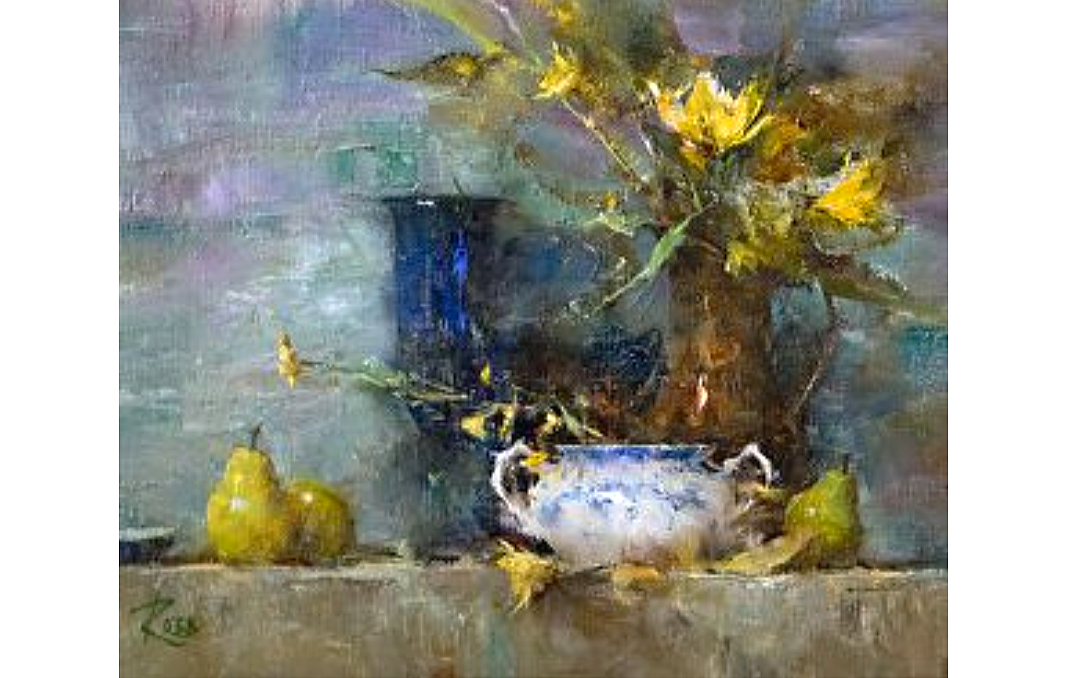
One of the biggest advantages of painting pears is their dramatic value range.
The light side of a pear may sit high on the value scale, while the shadow side can drop dramatically darker. This means a single pear can span almost the entire value scale.
That range makes pears far more challenging than many other still-life objects.
For comparison:
A red apple may only cover a short value range
A pear often spans a much broader value spread
This makes pears an excellent study for learning how light moves across form.
The Hardest Skill in Painting: Light on a Light Object
Laura believes one of the most difficult challenges in painting is accurately capturing light on light-valued objects.
When an object is already light in value, subtle shifts in value become extremely important. Small mistakes quickly destroy the illusion of form.
But when an artist learns to truly capture this light — to make an object feel illuminated — the results can transform their work.
A simple pear can become a powerful study in how light behaves.
The Historical Tradition Behind This Practice
Laura’s approach is not new. In fact, it connects to a long tradition in classical art training.
In the Paris academies, students were expected to study the human head extensively. Skin tones often span a large value range, making them difficult but incredibly valuable subjects to paint.
The belief was simple:
If you can paint a head well, you can paint almost anything.
While Laura believes artists should eventually expand beyond one subject, the principle still holds true. Focusing on a difficult visual problem can accelerate learning.
Practice Before Performance
Laura often compares painting practice to other disciplines.
Musicians practice scales.
Dancers repeat steps endlessly.
They don't simply walk on stage and perform.
Painting should be no different.
Artists grow faster when they practice specific visual problems rather than constantly aiming to produce finished paintings.
The real reward is not praise or sales — it is growth.
An Even Greater Challenge: The Butternut Squash Study
For artists ready for another challenge, Laura sometimes recommends painting a butternut squash.
This unusual subject shares many of the same qualities as a pear:
A wide value range
A subtle, flesh-like color
A smooth surface that reveals form clearly
In many ways, it resembles the value structure of a human head — but without distracting facial features.
This allows artists to focus entirely on the fundamentals:
Form
Light
Value relationships
What Students Should Ignore
When painting studies like pears or squash, Laura advises artists to ignore small details.
Do not focus on:
Tiny surface lines
Minor blemishes
Small ridges or marks
Instead, concentrate on the larger visual problem:
Is the form turning?
Does the light feel believable?
Are the value masses clear?
Laura would rather see one object that truly feels illuminated than a complicated still life filled with objects that lack convincing light.
The Real Goal: Growth as an Artist
In Laura’s teaching, the goal is not simply to produce finished paintings.
The goal is to understand light.
To understand form.
To learn how values create the illusion of reality.
If an artist stays focused on these problems and practices deliberately, the improvement will show in every painting they create.
And eventually, those humble studies of pears may lead to something far more important:
A deeper understanding of how painting truly works.
Join Laura through her webinar or self-study below: